

(in alphabetical order)
Baloubet du Rouet:
It is one of the most successful horses ever: „Baloubet du Rouet“ accomplished the almost impossible. The Selle Francais stallion jumped with the Brazilian Rodrigo Pessoa to Olympic gold in the individual competition in Athens 2004 and won the World Cup final three times in a row with his rider (1998, 1999 and 2000). The fox, born in 1989 and descended from „Galoubet A“, is still one of the most influential offspring. Today, the stallion, which was used for breeding until 2010, lives with his owners in Portugal, where he enjoys his final days.
Big Star:
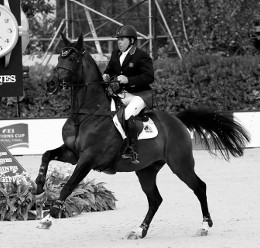
He is already legendary in his lifetime: Big Star led the British team to the Olympic victory in London in 2012 – at that time, the KWPN stallion from Quick Star was just nine years old. Four years later, with his rider Nick Skelton, he also won the gold medal in the individual event in Rio. And that was despite the fact that he had already been written off by many after an injury to a tendon and a long break. That Skelton and his horse could triumph in Rio is not least due to the doctors. Both of them have a long history of illness behind them; Skelton suffered several broken bones, the worst of which was a neck fracture that seemed to have already ended his career. He returned to the saddle, but the doctors warned him: any further falls could lead to him being put in a wheelchair. But Nick Skelton never lost faith in himself and his horse. He linked his own career end to that of Big Star. „If he goes, I go too.“
Casall Ask:
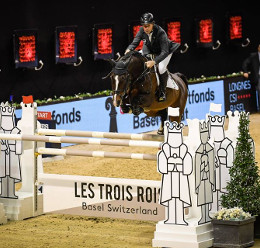
Casall Ask is one of the absolute top horses in international show jumping, but as a sire he is also a class apart. At the major championships of recent years, the Olympic Games in London 2012, the European Championships 2013 in Herning and the World Championships 2014 in Caen, he each reached the final of the top 25. In Herning he won the bronze medal in the team competition with the Swedish team, and in addition he placed fourth in the individual competition. In his starts in the Global Champions Tour 2014, he reached the final 6 times, being able to win the qualifying tests in Chantilly and Doha and finishing second in the overall ranking of the Global Champions Tour, tied with the winner Scott Brash.
In the 2015 season, the stallion won at the Global Champions Tour in the Grand Prix events in London and Rome and finished third in the overall standings. In 2016, these results are topped off by Bengtsson and Casall’s overall victory of the tour.
In 2017, the Holsteiner Association stallion turns 18 years old and is still very successful: In Basel, he won the Grand Prix at the beginning of the year with Bengtsson.
Cassini:
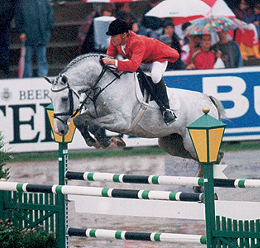
At his first public appearances, Cassini I impressed with his outstanding jumping ability, which was rare for a young horse. He also demonstrated this natural ability in the show jumping course. With Bo Kristoffersen, he won four qualifying tests for the national championship at the age of six, and was the winner in the first final qualifying round. At the age of nine, he won the national prize with the Danish team in Helsinki and was a participant with Bo Kristoffersen at the European Championships in 1997 in Mannheim. Subsequently, he switched to the training of Franke Sloothaak. Together they were the winners of the Grand Prix of Arnheim and Modena. Furthermore, they were part of the successful German national prize team from Aachen and Modena. Their achievements included excellent results in London, Leipzig, Dortmund, and Paris.
In addition to his impressive career as a racehorse, the special value of Cassini I lay in his unique breeding qualities. So far, 68 of his sons have been bred in Germany. Two of his offspring reached the final of the 2004 Olympic Games in Athens. The stallion Cavalor Cumano, a son of a Landgraf I-Caletto II mare, was also the winner of the highest-paid jumping competition in the world in Calgary in 2004 with Jos Lansink and Olympic with Steve Guerdat. Cavalor Cumano, a son from a mare by Landgraf I-Caletto II, also won the world championship in individual jumping in Calgary in 2004 with Jos Lansink and was third in the Grand Prix of Aachen in 2005. With Cavalor Cumano ridden by Jos Lansink, Cassini I became the world champion in the individual competition in 2006, and with Eurocommerce Berlin under Gerco Schröder another of his sons was represented in the Dutch team that won the gold medals. In 2007, at the European Championships, he competed with Cavalor Cumano as the vice-champion and with Eurocommerce Berlin once again as a horse of the Dutch gold medal team.
Cornet Obolensky:
Father „Clinton“ was one of the most successful jumping horses in the world under rider Dirk Demeersman; his son „Cornet Obolensky“, the Belgian chestnut stallion, took it to the top of the jumping sport with Marco Kutscher. Among Kutscher and „Cornet Obolensky“„s (born 1999) greatest achievements are a third place at the German Championships in 2008 and a team gold medal at the European Championships in 2011. Both also won the Zurich World Cup jumping event in 2012. In the German team, they contributed to the victories in the Samsung Super League final in 2008 in Barcelona as well as in the Nations Championships in Rotterdam 2008, 2011 and 2012 and in Rome 2012. His offspring are also promising: as early as 2010, at the age of eleven, the top stallion had around 50 foals and several state-prize mares as daughters. Currently, internationally successful sons include the stallion “Cornado NRW„ ridden by Marcus Ehning and “Cornet d’Amour” ridden by his rider Daniel Deußer.
Cumano:
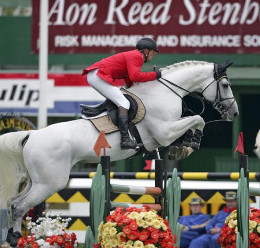
Cumano, born in 1993, is the son of the successful stallion Cassini I, who was successful with Franke Sloothaak. His mother comes from Landgraf I and carries further Holsteiner performance blood through Caletto II. As a young horse, the giant chestnut stallion impressed with his harmonious appearance, his light-footed gallop and the incredible jumping ability, which is paired with perfect technique. Under Lansink, Cumano not only won the World Championship in 2006; in 2007, there was also silver at the European Championships in Mannheim. Moreover, the pair won the highly coveted Grand Prix in 2004 in Calgary. Already in 2004 in Athens, Lansink and Cumano were part of the Belgian team at the Olympic Games; in 2008 in Hong Kong, the pair placed 9th at the Olympics. Furthermore, in 2005, the duo narrowly missed out on a medal at the European Championships in San Patrignano as fourth place finishers.
Darco:
He is considered one of the most important jumping horse breeders: the dark brown stallion „Darco“ competed in the European and World Championships with his Belgian rider Ludo Philippaerts and took part in World Cup finals. At the 1992 Olympic Games in Barcelona, the pair placed seventh in the individual standings. The father of the exceptional jumping horse (born 1980, died 2006) was the Hanoverian stallion „Lugano van la Roche“, whose mother was the Holstein stallion „Codex“. As the father of more than 3,000 horses, many of which were active in top-level sport or are still active, „Darco“ is considered one of the most important jumping horse breeders of the present day. Until 2011, he held the ranking of the jumping horse breeders of the World Breeding Federation for Sport Horses (WBFSH), but in 2012 he was ousted by the successful stallion „Baloubet du Rouet“. Well-known descendants of „Darco“ include, among others, „Winningmood“ (riders: Ludo Philippaerts and Luciana Diniz), „Sapphire“ (McLain Ward), „Socrates“ (Edwina Alexander) and „Narcotique de Muze“ (Eric Lamaze).
Deister:
He won the European Championships three times in a row with his rider Paul Schockemöhle and won five German championship titles: „Deister“, a dark brown Hanoverian stallion from „Diskant“ from the „Adlerklette“, with 76 victories and a lifetime earnings of 1,429,350 D-Mark is to this day among the most successful show jumping horses of all time. The horse’s character was characterized by toughness, endurance and fighting spirit. He demonstrated outstanding gaits in tight combinations and turns, without losing his jumping power, even though „Deister“ was not always easy to handle. At that time, this show career had little to do with it. „Deister“ (born 1971, died 2000) was sold in 1974 at the Verdener Auction for 17,000 D-Mark as a dressage horse after difficult training attempts; he had become second in a material test as a potential dressage star. However, because he proved to be too curious for dressage, at the age of five he came to Hartwig Steenken, who trained him as a show jumper and with whom he became second in the Grand Prix of the Verdener Hallenturnier in 1977. When Steenken tragically died shortly thereafter, „Deister“ went to Paul Schockemöhle for 200,000 DM. The successful duo continued to compete together until 1989. After retiring, „Deister“ lived on the pasture for another eleven years before dying in Mühlen in 2000 at the age of 29.
E.T. FRH.:
With 3.2 million euros, it is one of the most profitable jumping horses in the world. For its rider, the Hanoverian horse Fuchs Wallach „E.T. FRH“ (born 1987, died 2013), descended from „Espri“, his life’s horse: In 1995 Hugo Simon won the Hamburg Spring Derby with „E.T.“, in 1996 they were fourth at the Olympic Games in Atlanta and won the World Cup final in Geneva, in 1997 the pair won the World Cup final in Gothenburg and took second place at the European Championships in Mannheim, in 1998 they triumphed in the Grand Prix of Aachen and the Grand Prix of Monterrey and thus also won the so-called Pulsar Crown, which with 800,000 US dollars was the most highly-paid jumping series in the world at the time. In 2004 Hugo Simon said goodbye to his four-legged partner during the horse festival in the Wiener Stadthalle with a final flourish before he put him to rest forever.
For Pleasure:
With him, the current leaders Marcus Ehning and Lars Nieberg started their international careers: „For Pleasure“ (born 1986, died 2011) was a Hanoverian stallion and a German world-class jumping horse. The lifetime earnings of the Dunkelfüchse from „Furioso II“ from the „Gigantin“ amount to more than 1.83 million euros. He won gold in the team jumping at the 1996 Olympic Games in Atlanta and the 2000 Games in Sydney, several European Championships and German Championships, as well as numerous trophies at the major European championships. In 2003, „For Pleasure“ was named the most successful jumping horse in the world by the renowned World Breeding Federation for Sport Horses. However, two weeks before the 2004 Olympic Games in Athens, “For Pleasure„ became injured and was unable to compete. In 2006, the world-class horse was retired from competition as part of the CHIO in Aachen. At the age of 25, the stallion died on the 18th. February 2011 on a stable belonging to the Ehning family.
Gold fever:
Together, they won the Grand Prix in Aachen in 2002 and 2003; together, they won team gold at the 2000 Olympic Games in Sydney; in 2007, the Dreamteam won team silver at the European Championships in Mannheim; and in the individual competition, the stallion „Goldfever“ taught the competition a lesson: The Fuchs (born in 1991), descended from a mare by „Grosso Z“ by the Zangersheide stallion, was unbeatable as a duo and taught the competition to be afraid. Today, the Fuchs (born in 1991), who descends from the Zangersheide stallion „Grosso Z“ and is a son of a mare by „Galvano“, is one of the most successful showjumping horses of all time with a prize money of around 2.8 million euros. After his sporting career, the stallion is used in breeding. His outstanding breeding qualities are evident in his daughter “Gotha”, who is now internationally successful with Ludger Beerbaum and today with Henrik von Eckermann.
Hello:
She was the „miraculous mare“ and already a legend in her lifetime: „Halla“ (born in 1945, died in 1979) captured the hearts of spectators at the 1956 Olympic Games. As a myth, the Hessian mare from „Helene“, a French war horse of unknown ancestry, and the Trappet stallion „Oberst“ became the star when she carried the severely injured Hans Günter Winkler flawlessly and virtually alone over the Olympic course in Stockholm. „It was like when the captain of a ship has fallen ill and the helmsman has taken over the navigation alone,“ Winkler raved in his book „Halla, My Horses and I“. The rider had torn a muscle in his shoulder in the first round of the Olympic course. Despite this, he rode „Halla“ to the start, screamed loudly in pain over the obstacles and still remained flawless. With this, the Germans won the team gold medal and Winkler became the Olympic champion in the individual competition. For a long time, „Halla“ was considered difficult to train; she often changed riders until she came to Winkler in 1951. „Halla had human intelligence,“ this rider praised her successful horse. At the age of 34, the mare died, which after her success had given her eight foals. Today, in Warendorf, the seat of the German Equestrian Association (FN), a life-size bronze statue commemorates the equestrian wonder. In honor of her, the FN has blocked the name „Halla“; no tournament horse may be registered with the name „Halla.“.
Jappeloup de Luze:
At 1.58 meters, he was very small, but that did not prevent him from becoming a truly great figure in equestrian history: „Jappeloup de Luze“ (born 1975, died 1991) was one of the best jumping horses in international sport in the 1980s. Remarkably, especially when one considers his pedigree: a Trakehner as a father and a full-blooded mare. Even his rider Pierre Durand did not initially really believe in the small and too thin Selle Francais stallion; however, he eventually became convinced by its tremendous jumping power. Their joint career began with a victory at the French Championships, but it reached a low point at the 1984 Olympic Games in Los Angeles, when „Jappeloup“ carried his rider into a hurdle. Nevertheless, Durand continued to work intensively with Dunkelbraunen and it paid off: 3rd place in the World Cup, bronze medal in the team competition at the World Championships and 4th place in the singles, gold in the singles and silver in the team competition at the European Championships, and then also 4th place in the team competition and gold in the singles at the Olympic Games in Seoul 1988. There were many more titles to follow, until „Jappeloup“ was officially retired from the sport in 1991 at the Eiffel Tower. In 2014, the film „Jappeloup – A Legend“ was released in German cinemas.
Meteor:
He was one of the most successful and famous jumping horses of his time: the Holsteiner stallion „Meteor“ from „Diskus“ (born 1943, died 1966) took part in three successful Olympic Games under his rider Fritz Thiedemann and won more than 150 jumping competitions over the course of his life. The career of the „Big One,“ as he was nicknamed, had not started very promisingly: The huge brown horse was initially a lead horse in front of a milk truck. Fritz Thiedemann bought the horse for 2250 D-Mark and turned it into a jumping horse. In total, „Meteor“ produced a lifetime income of 177,361 D-Mark. Today, the „sturdy bull“ (Thiedemann’s own words) stands as a bronze statue in front of the Kiel Agricultural Ministry.
Milton:
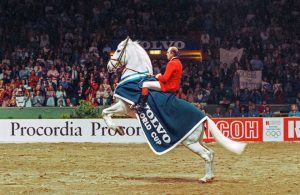 For his rider John Whitaker, he was the „once in a lifetime“ horse, the favorite for the audience most of the time: Milton is still considered one of the most successful horses of all time. He won over one million euros in prize money. With the chestnut stallion (Marius x Any Questions), the Briton won twice in the final for the World Cup (1990 in Dortmund and 1991 in Gothenburg), he was twice Team European Champion (1987 and 1989) and once Individual European Champion (1989 Rotterdam). In 1990, the successful pair also became vice world champions in Stockholm. The discoverer of Milton was Caroline Bradley, who led the world rankings in 1978. After her heart attack in 1983 at a tournament, the parents made John Whitaker available to the rider, but he was initially only allowed to compete in championships and not in the Olympic Games. Before the 1992 Barcelona Games, the Bradleys were persuaded for the first time to let Whitaker ride Milton. But the mold had already exceeded its performance limit. The pair returned to England without a medal.
In 1994, Milton ended his career after the International London Horse Show Olympia. Milton died on July 4, 1999. He was buried at Whitakers Farm in Yorkshire.
Nino of the Buissonnets:
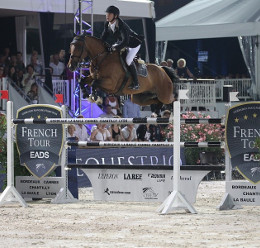
„Nino is a phenomenon – a treasure in the ring and on our rides in the forests – but when he sees an obstacle, he becomes a beast!“ That’s how Steve Guerdat describes the genius in the course, Nino des Buissonnets. And the Swiss top rider must know it: With the brown Selle-Francais stallion Kannan, Guerdat won the 2012 London Olympia title. The wunderkind’s career began with exciting jumping competitions in France, before he was bought by Baden-Württemberg rider Manfred Marschall for his son Marcel. Under Marschall’s trainer Tim Hoster, Nino collected his first international successes. At the end of 2010, the stallion was bought by Thomas Fuchs for Urs Schwarzenbach bought and henceforth owned by Steve Guerdat Riding. And the ascent began: At the Olympic Games 2012 In London, the Stallion became an Olympic champion under Guerdat. As the only horse, he remained error-free in both rounds of the individual final. The World Cup starts of 2013 and 2014 also went very successfully: After Guerdat and Nino des Buissonnets were able to finish second in the World Cup jumping events in Oslo, Helsinki and Stuttgart in the autumn/winter of 2013, they won in Helsinki the following year. In Oslo and Stuttgart, they each finished third.
Four years after London, Nino of the Buissonnets was once again Steve Guerdat's Olympic horse. At the Olympic Games in Rio de Janeiro Both remained error-free in both rounds of the individual final. In the tiebreak, a hurdle error prevented a podium finish; it was the fourth place in the individual standings. Subsequently, Guerdat announced that this was the last championship for Nino des Buissonnets.
Guerdat brought the horse to the finish line for the last time CHI Geneva Launched in December 2016. The goal was for Nino des Buissonnets to end his career at its peak, healthy and energetic. In the Grand Prix of Geneva, Steve Guerdat and Nino des Buissonnets made it into the final, so there was a chance of repeating the victory from the previous year. But that did not happen; eight penalty points were added. Following the test, the riders and the audience solemnly bid farewell to Nino des Buissonnets.
Ratina Z:
She is considered the most successful champion horse in show jumping: „Ratina Z“ won two Olympic team gold medals (1992 in Barcelona under Piet Raijmakers and 1996 in Atlanta under Ludger Beerbaum). The Hanoverian mare „Ramiro Z“ from the „Argentina Z“ (born 1982, died 2010) won the World Cup final with her successful rider Ludger Beerbaum in 1993, became team world champion with him in 1994 and double European champion in 1997. In total, the brown mare earned a profit of around 920,000 euros. In 2000, „Ratina Z“ was retired from competition and was sent to the stud farm in Riesenbeck, where a bronze statue still stands today.
Shutterfly:
He is considered the most successful show jumper of the 2000s: With a lifetime earnings of 3,520,864 €, „Shutterfly“ is the most profitable show jumper of all time. The Hanoverian stallion born in 1993, which initially carried the name „Struwwelpeter“ and after its sale received the more easily pronounceable name „Shutterfly“, brought him world fame together with his rider Meredith Michaels-Beerbaum. Together they won several medals at world and European championships, took the title three times at the 2005, 2008 and 2009 World Cup Finals and won the Grand Prix of Aachen in 2005. In 2011, the Brown from „Silvio I“ was retired from the sport here, in front of thousands of spectators, following a „Forest xx“ mother. A few days earlier, together with Meredith Michaels-Beerbaum, he had won the European title here – at the age of 18.
Simona:
She was rather small at 1.62 hands and also a bit stocky: But the fox mare „Simona“, formerly „Weinglück“ (born 1958, died 1987), from the state premium mare „Angelbeute“ by the equestrian „Weingeist“, was a huge jumping talent. As can be read in the training protocol of the Verden horse auction: „Weinglück jumps like a rubber ball with any size, regardless of how she gets to the obstacle. She makes no mistakes at all. A horse of exceptional class. Trained in two-handed riding.“ The Bremen coffee merchant Walther Johann Jacobs first acquired the horse for his son Klaus. But because the mare was prone to problems with her front hooves, Jacobs soon sold the horse back, and the mare came to the later national coach Herbert Meyer. In 1968, he offered „Simona“ to Alwin Schockemöhle, who bought it subject to a reservation. After a veterinary examination and an assessment that the legs would not hold in the long term, „Simona“ returned to Herbert Meyer – who promptly sold her to Horst Ebert, the sponsor of the young and ambitious show jumper Hartwig Steenken. Already in 1969, „Simona“ and Hartwig Steenken won the first German Championship; in 1970 and 1973, two more followed. In 1971, the duo was successful at the European Championships in Aachen Soers; in 1972, they were decorated with gold in the Olympic team jumping in Munich. The two Lower Saxony riders experienced the highlight of their career in 1974, when they won the title at the World Championships in Hickstead.
King of the Waltz:
He was big, had enormous jumping ability and was nicknamed „Herrmann“: the Hanoverian stallion „Walzerkönig“, from „Watzmann“ in the „Ahnenkrone“ of „Absatz“, was a winner-type. Under the saddle of Franke Sloothaak and Rene Tebbel, the fox (born 1979, died 2000) won almost all Grand Prix jumping competitions in Europe: he became German champion in 1989 in Berlin and 1991 in Münster, won the Grand Prix of Aachen in 1990, triumphed in London in 1991 and even won twice at the Zurich Classics in 1988 and 1991. His winnings amounted to 1.3 million D-Mark. His greatest success in 1988 was winning the gold medal under Franke Sloothaak with the German team at the Olympic Games in Seoul. His favorite food was Schockemöhles Hof in Mühlen, where he shared the pasture with the spring legend „Deister“.
… to be continued …
(This list does not claim to be exhaustive.)