

Vertical jumps
A steep ladder is a climbing ladder and is built from two stands, poles, planks, and other movable materials.
There are three variants:
- One Rick consists only of rods.
- Planks They are wider and more noticeable than poles, but can be irritating to horses. On the other hand, they appear more massive than poles, which causes the horses to be more cautious when jumping.
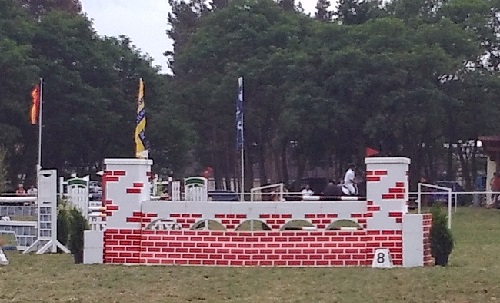
- One Wall It consists of opaque wall sections that can be adjusted in height depending on the design. One wall is opaque, so the horses cannot see what is directly behind the wall. If the horse jumps over the wall, it is rarely torn, as the massive appearance causes the horses to be extremely cautious.
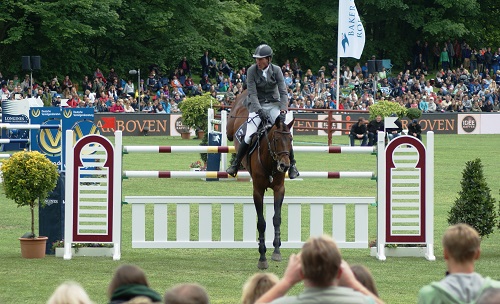
Here's a big jump:
Here is a wall:
High-water jumps
A trestle bridge is usually built from four stands, poles, planks, and supporting elements.
Three variants:
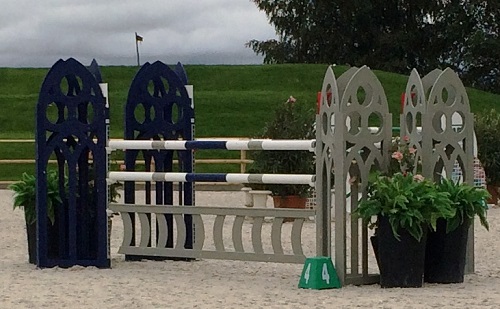
- One Oxer consists of two vertical elements of the same height. The distance between the front and rear bars can be up to two meters.
- The Triple bar consists of three ricks that rise rearward in height. The flight path must therefore be at the highest point above the last rod and not centered above the jump.
- embellished water moat
Here's an oxer:
Long jumps
- Waterway (width of 2.50 meters at A** and maximum 4.50 meters at S***)
Combination
A combination consists of several jumps, between which one or two galloping jumps are included. A combination of two jumps is called a double combination, a combination of three jumps a triple combination.
In-Out
If there is no galloping between the jumps and the horse has to jump back up immediately after landing, this obstacle is called an in-out. In-outs must not be too high. They are particularly popular in gymnastics routines and in the high jump, as they train the sense of rhythm and teach anxious horses to concentrate.