

The International Jumping Riders Club (IJRC) calls on the FEI to further review the changes in the costs and procedures for participating in CSIs, as young riders, aspiring athletes and sports breeders are being pushed out of the sport.
Starting fees and related costs have increased, while the real value of prize money can vary greatly due to currency fluctuations in different countries.
A „gray area“ in the quota procedures for riders means that some organizing committees (OKs) can offer places for „pay cards“ at the last minute, instead of for riders selected based on their performance.
Starting and prize money:
Previously, the FEI set the amount of prize money and entry fees based on the historically strong Swiss franc (CHF). After a conference in London in 2011, the FEI allowed the organizing committees to set these amounts based on the consumer price index and the inflation rate in their own countries. Since then, the real value of prize money has decreased by an average of 8.3 % %. The fluctuations are particularly noticeable when paid in the two main currencies of the CSIs, the Euro and the US dollar.
Given the rising costs of tournaments, the International Equestrian Organisers Alliance last year proposed a new regulation based on the consumer price index in Belgium, one of the highest in Europe, which has risen by 18.32 % over the last eight years. The IJRC raised an energetic objection, but the FEI did not accept the organizers’ plan, but proposed a 10 percent increase in entry fees, which is even more disadvantageous for riders and owners.
Currently, the maximum entry fee required by the FEI is generally collected even when a minimum prize money is announced. The entry fee includes the stables, but not the ancillary services such as electricity supply and sewage disposal, whose costs in recent years have % increased the riders’ expenses by up to 70 per tournament. At some CSIs 3* and 4* on the European tour, riders must pay additional fees of up to 20 euros per day for electricity, 100 euros per week for parking horse transporters, and 300 euros for a saddle room, as well as 30 euros per day for housing a horse in a stable during the short break between tournaments.
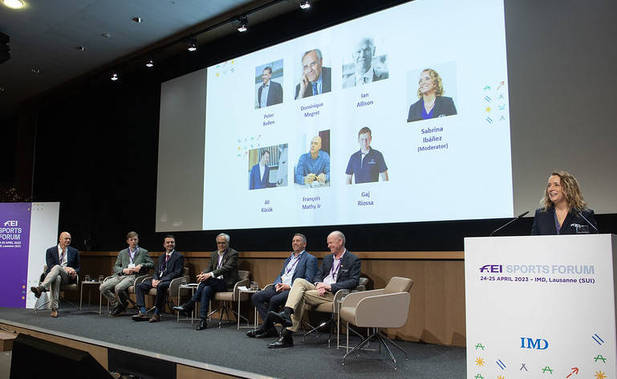
Meanwhile, at the 2023 FEI Sports Forum in Lausanne on April 25, a possible solution for the prize money from 2024 was presented. According to this, the prize money would once again be set in euros instead of in CHF, with an initial conversion rate of 1.10 in US$ dollars proposed. The fluctuations would be averaged over a period of 12 months, and the system would only be changed if a threshold of 5 % was exceeded.
The IJRC appreciates the work of the FEI on the new prize money proposal and understands the impact of rising costs on the organizers, but is of the opinion that further consultation of the stakeholders is necessary, especially if a formalized proposal for discussion must be available in the FEI Executive Board no later than August. The IJRC believes that the entire industry has a moral obligation to keep costs as low as possible.
IJRC Director Eleonora Ottaviani also warned against global harmonisation of prize money and start-up fees systems, especially in Europe and North America, where the markets and CSI business models are completely different.
She said: „One must also take into account that in addition to the entry fees stipulated in the FEI regulations, in Europe there is an increasing number of taxes that do not comply with the FEI regulations, such as payment cards, tables, administrative fees, etc.“
„These fees affect especially young riders, breeders, and
for aspiring athletes who deserve and can afford to train in a
in a sport that respects the meritocracy. The increase in the starting prize money and the
The costs, which are already expensive for Central and Southern Europe, become unaffordable for all of Eastern Europe, where sport is currently undergoing a promising development.“
François Mathy Jr., Vice President of the International Jumping Riders Club (IJRC), commented: „Our goal is to keep our sport accessible to young and talented riders. A compromise must be found to stop the race of fancy extras that some events impose on riders.“
Invitations:
In the same spirit of the performance society, the IJRC is calling on the FEI to reconsider two other invitation processes for riders – the reallocation of unused places at CSIs and the Wild Card, after there are indications that more last-minute applications are finding their way to „Pay Cards“.
The categories of riders who can participate in a CSI can be viewed here: FEI Jumping Rules_Annex_V_Implementation_Guidelines_update_2023.pdf. In order of priority, these are the FEI Longines ranking list, riders nominated by their national federation, riders personally invited by the OK, and the Wild Card.
The sensitive issue is the invitation by the organizing committee, which can be privately extended to riders further down the ranking list or even to non-ranked riders who can afford to pay a significant surcharge on the fixed starting fee; some also buy a hospitality table for the week as an informal condition for participation. This unofficial but widespread practice is colloquially referred to as „Pay Card“ and is an essential component of the business model for many tournaments.
According to the current FEI regulations, the place of a rider who drops out of the ranking list after the registration deadline can be replaced by an OK invitation. The IJRC calls on the FEI to re-allocate these places to riders from the ranking list.
Similarly, there are indications that aspiring riders are missing out on Wildcard opportunities because the window for using them is short. Currently, the Wild Cards must be re-issued by the second Monday before the tournament begins; otherwise, they will also revert to the OK. The IJRC believes that Tuesday or Wednesday of the previous week is a more realistic timeframe, especially if a place is announced over the weekend when the national federation offices are closed.
The IJRC is aware that adding an additional fee for the OK is an attractive prospect, but it is clearly undemocratic! Reducing the number of riders placed at a competition can weaken the quality of the competitions for spectators and the broadcast, and this at a time when awareness of the „social license“ is growing and the FEI is otherwise working to improve equestrian standards and the public perception of our sport. (IJRC)