

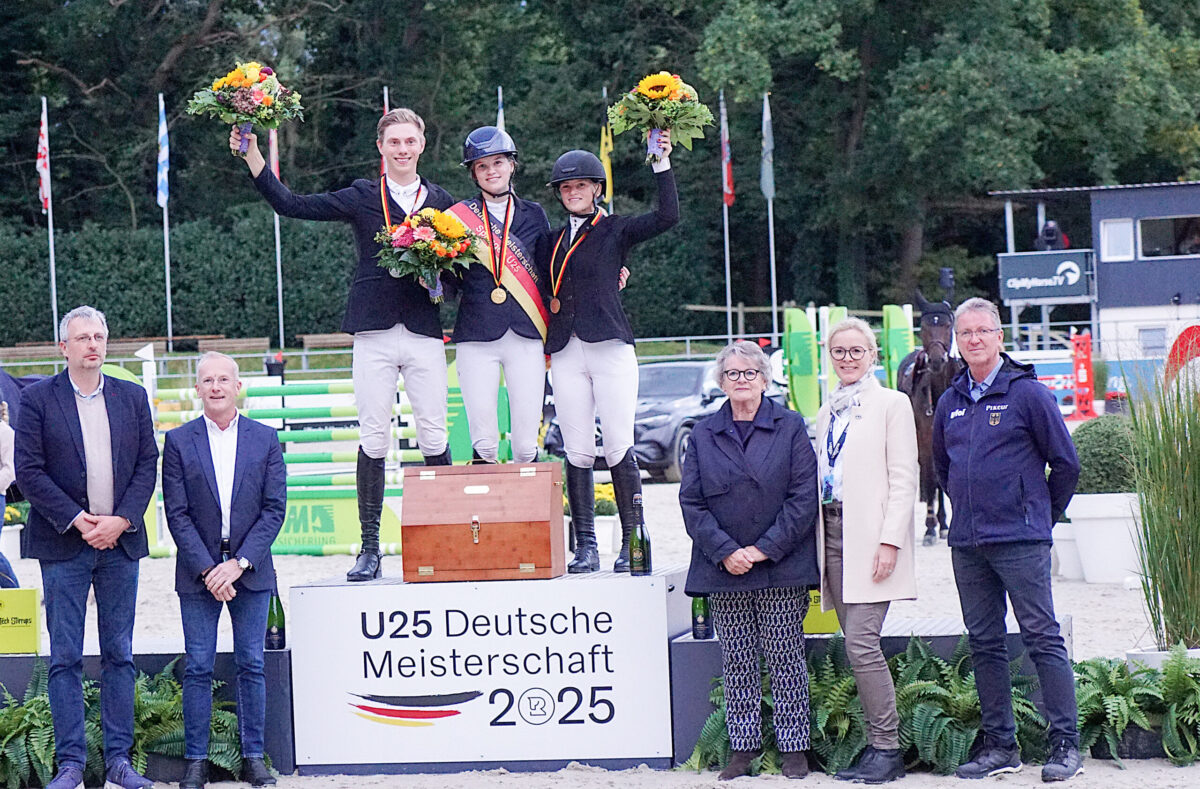
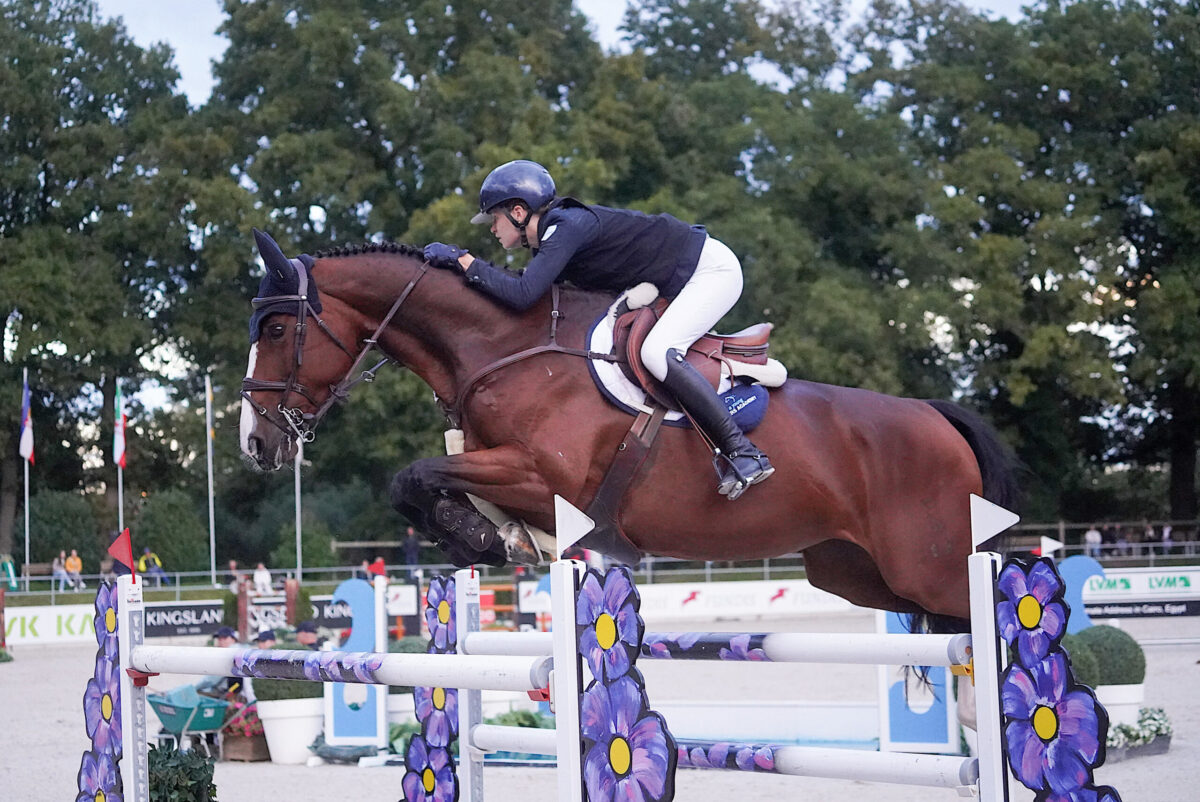
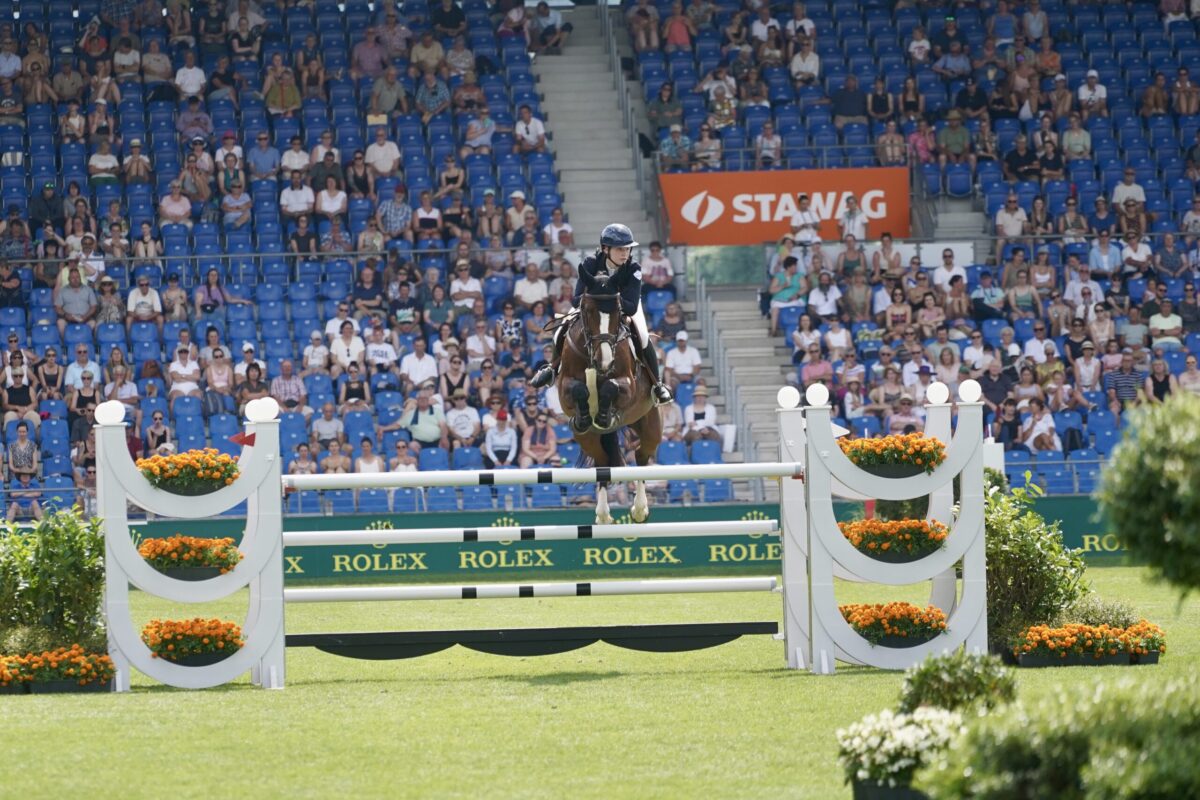
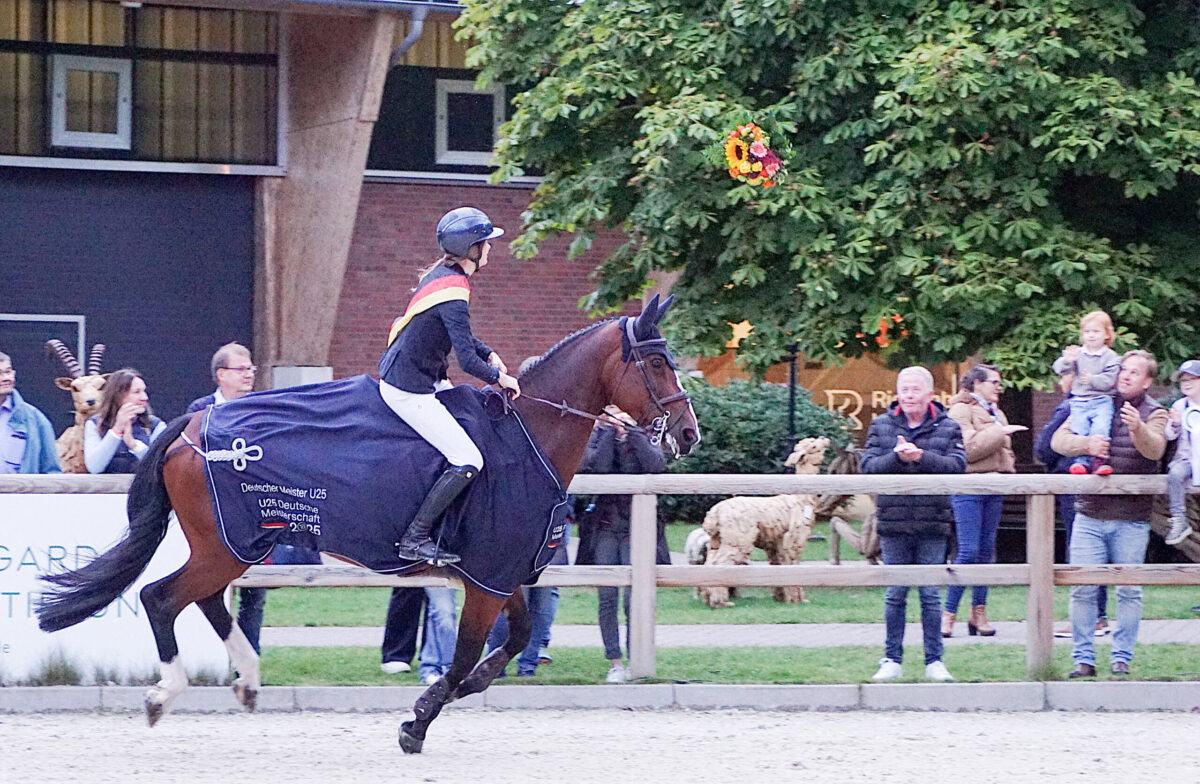
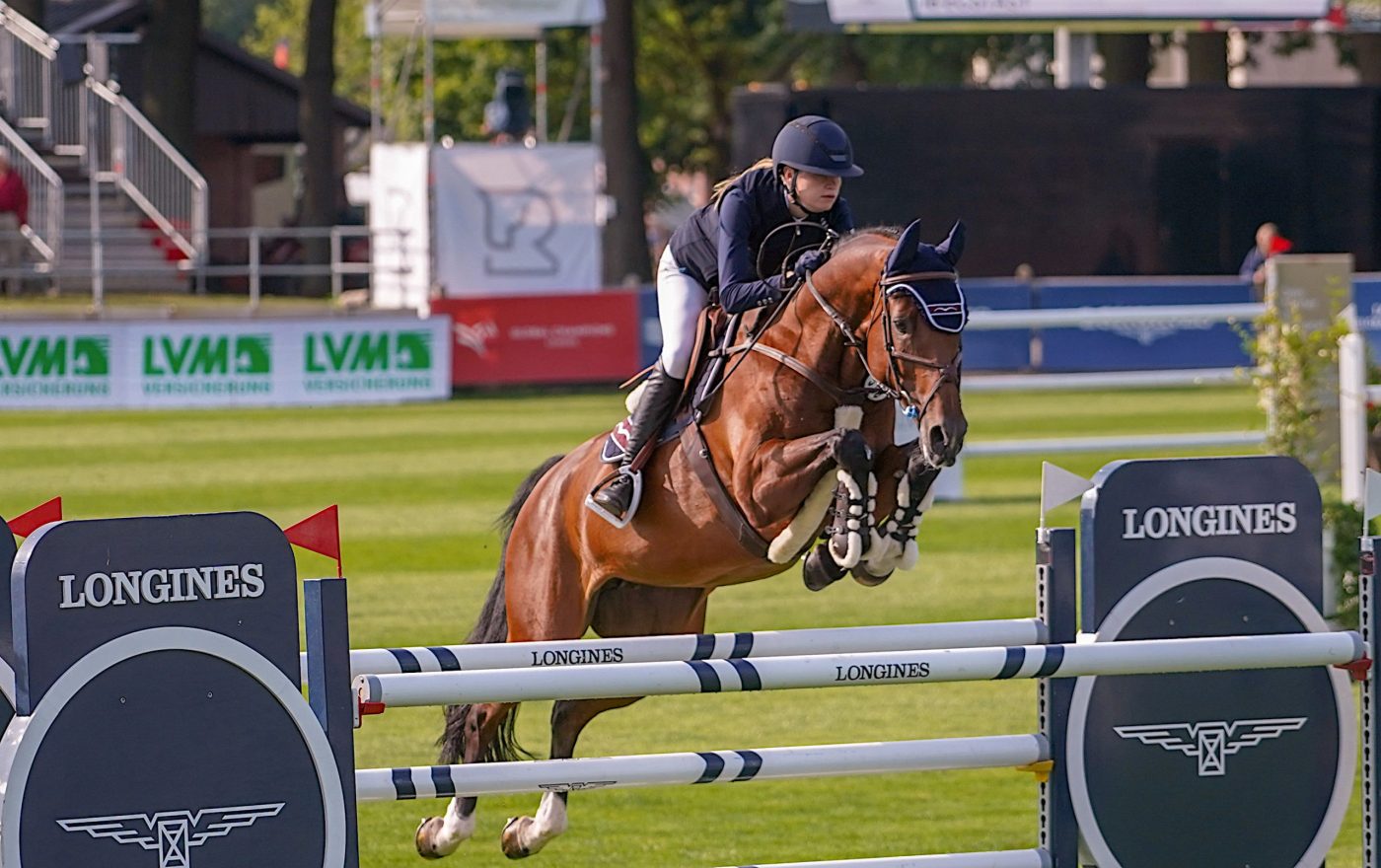
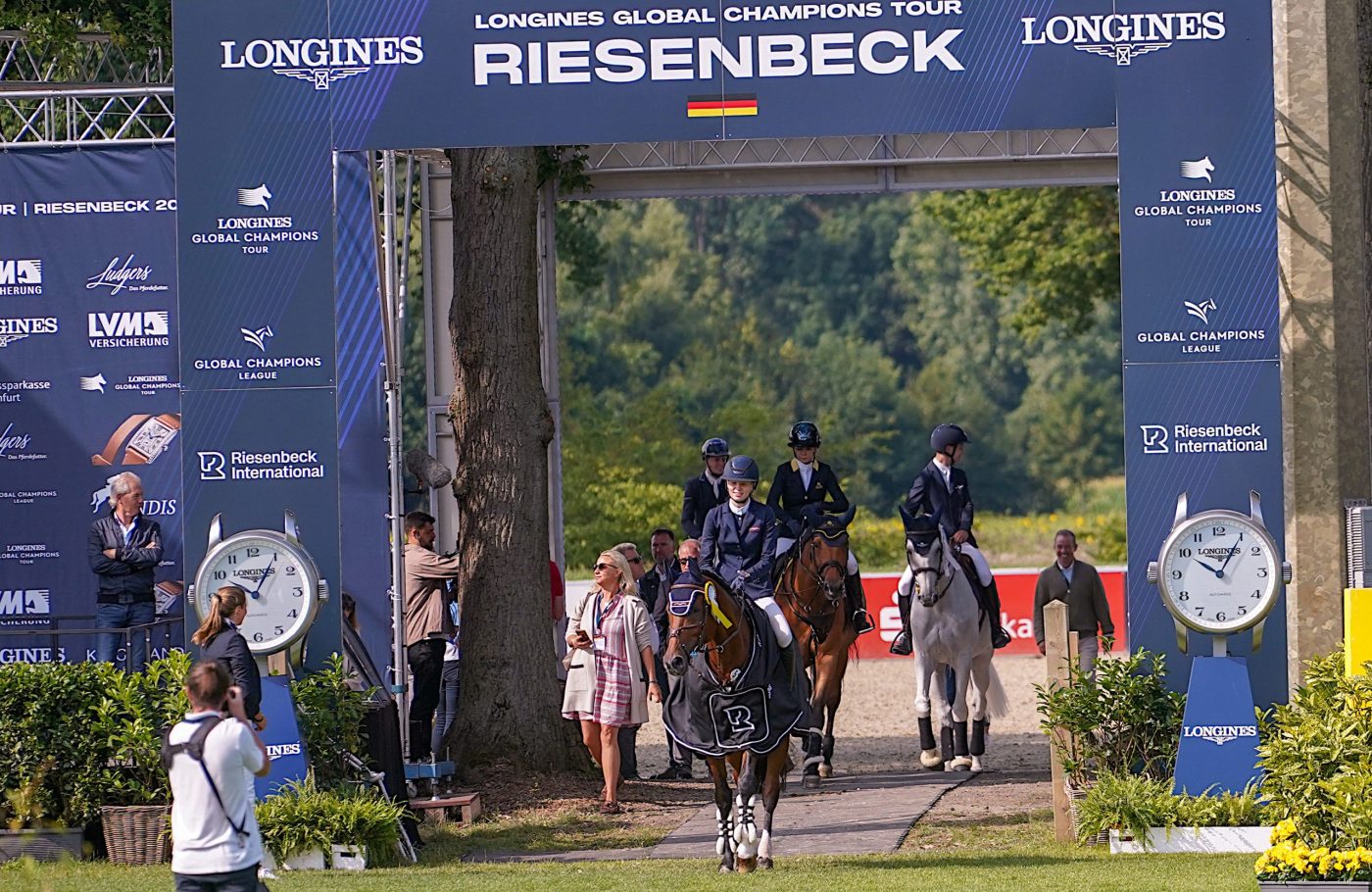


At the age of nine, she won her first L-jumping competition; at the age of 15, she became the German Pony Champion; at the age of 16, she won the title of German Champion for junior riders; at the age of 17, she received the Gold Riding Badge with a laudation from her uncle Tjark Nagel: Johanna Beckmann is one of the most experienced and successful German junior riders – she has represented Germany seven times at the European Championships for pony riders, juniors and young riders. In the summer, the 22-year-old rider secured the title of U-25 German Champion in Riesenbeck on the saddle of Emelie van de Mirania Stam. We spoke with the rider from Schleswig-Holstein about her path to success, her strong nerves, her passion, her philosophy with horses, the Young Riders Academy, and her priorities.
You became the U-25 German champion in Riesenbeck this late summer – how do you attribute this success?
Johanna Beckmann„That’s of course cool to start off so strongly in the first U-25 year and to be on the podium with close friends. That was already very special and we all celebrated afterwards together.
But Riesenbeck has always been a great success for me. In 2020, I became the German champion there with Cheenook in the junior category, and a year earlier I became the German champion in the saddle with Karim van Orchid’s ponies.
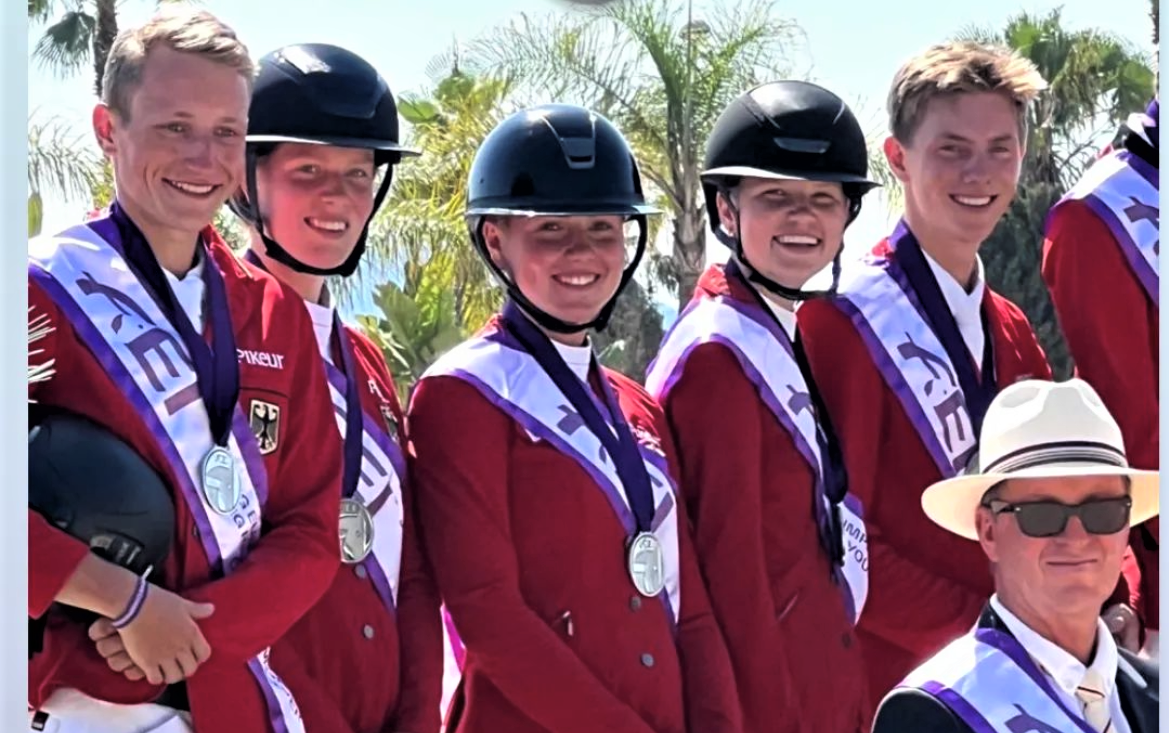
Winning the U-25 title this year also somehow confirms to me that I’m on the right path. However, my greatest title was definitely the silver medal with Emelie and the German team at the 2022 European Championships. That was a huge highlight.“
It feels like you still sat on a pony yesterday, you rode M-jumping in the team cup in Schleswig-Holstein yesterday, and today you’re starting at 5* level – that went fast…
Johanna laughs: „Yes, that’s true. I had a great opportunity, and I’m very grateful that I was able to ride with the Global Tour two years ago and that I was recruited by the Istanbul Warriors into their team in my first year as a junior rider. Due to the great quality of Emelie and Alphajet, I was entrusted with the task of achieving this, even though it might not be perfect yet. But we always managed to reach the finish line, and that was very valuable for us. It was a huge leap into the big sport.
The foundation for this was of course laid beforehand. The junior coach of the show jumping riders, Peter Teeuwen, sent me to countless national championships early on. At the age of 12, I was the first time at a European Championship. In total, that was seven European Championships. And that naturally left a huge mark on me. It gave me so much experience that I can now ride the difficult show jumping events with relative ease. I have always enjoyed working under pressure. And I believe I still benefit greatly from that today. And I am also very grateful to Peter for all the opportunities he has given me in preparation for the big sport.“
Are you naturally so calm – do you have nerves like wires?
Johanna smiles„I always think about it before the start: in two minutes it’s over, no matter what happens now. And then I just squeeze in the other one and a half minutes. And I want to make the best of the situation. I often started in the Nations Cup as fourth, and especially when I knew I had to somehow pull it off, my mind was kind of off, and that’s how I focus. I just like that. But of course it also has to do with the fact that I learned to deal with these situations so early.“
You were always very fast with the ponies too. Are you completely fearless?
Johanna„I have certainly experienced that it can also be very painful to take on a lot of risk. But when the success is there, of course you think the risk was worth it. I would always rather take the risk of being the fastest and then maybe making a mistake, than just going for a safe zero round. That wouldn’t be worth it to me.“
At what age did you realize that you wanted to be in the big sport and that horses would determine your life?
Johanna„I’ve actually always said: When I finish school, I’ll study and do the horses in the side. But that was of course pure theory and has nothing to do with my current practice. I already believe that the season at the Global Tour had a lot to do with me among all the pros. To be able to experience that and to know what a cool sport it really is. That made me even more emotionally dependent on the horses. But if I’m honest with myself, it was clear from the first pony that the horses determine at least 70 percent of my daily routine. That has never changed. And when you’re then allowed to celebrate your first major successes like at the Global Tour, that gives you an enormous boost. I can study for five hours every day, but that doesn’t give me as much as a horse to ride.“
To compensate, Johanna Beckmann is studying economics and law in the fifth semester – half business administration, half law – in Münster.
Johanna„I really, really like it, even though it’s very, very tiring in combination with riding. I ride about 75 percent of the time and study 25 percent. You have to want to do it, but I like the balance. Even though it’s often said that you have to cram in exams between the tests. Only when there are big highlights do I put the books aside and concentrate solely on the tournament.
With my studies, I can either do a master’s degree or take the state legal exam. Which of the two I’ll choose remains to be seen, but I’m keen to make up for the lack of physical exercise by doing something for my brain. Every time I’m done with the horses, I look forward to going to university, and when I’m done with studying, I look forward to going out for a walk with the horses.“
But don't you see yourself anywhere in the office soon?
Johanna laughs loudly: „No. Maybe half a day at some point. In practice, I can't imagine that right now, even though I've already done an internship in a law firm and was able to incorporate that into my daily life. But the horses will be the ones shaping and dominating the situation.“
Your family has always fully supported you from the pony age until now – family life revolves around the horses…
Johanna: „Yes, from the very beginning there was 100 percent support from my parents. My older brother, who was three years older, was also involved in sports and was always supported. And my mother used to ride dressage herself. I got a wonderful pony, Moonlight, from my great-aunt Johanna Huesmann. Horses play a big role in my family.“
What is your philosophy regarding horseback riding and the training of horses?
Johanna„We currently have 12 horses between the ages of 4 and 14 at our stable. Our philosophy is that we give the horses plenty of time to develop. Our horses take very long, very small exams. We have a great trainer who does a fantastic job with the young horses. We already tailor everything to the individual needs of the horses. Of course, I also ride Youngster exams and used to often ride the ponies at the national championships. I did a lot of that, but now it’s no longer possible to do that in terms of time.“
And how do you find new horses, how do you get horses?
Johanna: „We like to buy horses that we know. For example, Queen Frieda, whom we knew. Emelie came from Karl Brocks and Alphajet came from my trainer. I like it when I already have a personal relationship with the horses. But we also sometimes buy a young horse from abroad. Sometimes it’s also the case that you see an exciting horse at the training ground for a while and then ask if it’s for sale.“
What kind of horse is your ideal partner for sports?
Johanna laughs„Although I have a certain type, not all my horses correspond to it. Most of the time it’s the hotter horses that have a lot of drive, courage and a good forward momentum. I like that when the horses start off on their own and look for a jump and I can kind of ride along with them. Examples are the eight-year-old Esmeralda, Queen Frieda and Emelie; they have a lot of drive and are very motivated. Alpha, on the other hand, isn’t as responsive; he’s more like a real buddy and a bit more relaxed, but he’s also a very good horse. A good rider also has to be able to adapt a little; it’s not just about the horse.“
His former success partner, the 15-year-old Cheenook today, now enjoys life on his home pasture.
Johanna„He’s still my treasure, and he could still compete in tournaments physically. But he really deserves the pasture now. That’s the hardest part: recognizing when it’s time for a horse to stop competing in tournaments. In terms of sports, he’s become more cautious and smarter with age. But when I noticed that he really wanted to do well now, I thought, “Now’s a good time too.” Before he wants to do so well that it’s no longer possible. But of course I still struggle with this decision.”
Who are your role models? Who do you admire and who do you like to see riding?
Johanna You don’t have to think long about it: „Marcus Ehning. You’d think he doesn’t do anything on the horse because it just looks so inconspicuous and effortless, and yet the horses run so perfectly under him. It always looks beautiful and it’s incredibly effective. Maximum performance with minimal effort. That’s something I find quite astonishing.
It’s similar with Ben Maher. You wonder what he’s doing that makes the horse so happy. It doesn’t look like anything, and that’s kind of the art of it too. Riding is not a combat sport but a sport of feeling. I also admire Steve Guerdat and Marco Kutscher very much. They do nothing and yet accomplish so much. There is still a long way ahead of me.“
You have been training with Bernd Schulze Topphoff for eight years and this season you are also taking part in the Young Riders Academy and are receiving training from legends like Franke Sloothaak and Jeroen Dubbeldam. What are your experiences?
Johanna„The Young Riders Academy is an incredibly great opportunity. I feel incredibly privileged right now. Frank Sloothaak’s work as a dressage coach is incredibly enriching for me. Jerome Dubbeldam’s philosophy is fantastic. The way he handles horses is simply wonderful. And how Bernd can teach me how to interpret the course on the training ground is very enriching.
At the Young Riders Academy, however, it’s not just about riding; it’s about the entire management of the horses. We receive instruction from psychologists, physiotherapists, veterinarians, as well as farriers, and we also learn how to keep financial matters in check.“
Where do you see yourself in 10 years – where does the sport still have to take you?
Johanna„The most important thing is that after a stressful day, for example at university, I come out of the stables and the world is back to normal. That’s the most important thing for me. My mental health is based on 80 percent of the horses. When it comes to sports, I hope that in 10 years I will have become relatively well established in the big leagues. Of course, it’s a dream to ride for national titles and championships, to wear the red jersey. I may not be the rider who wins a big prize every week. My strength is rather in consistency; you can rely on me and I will always give my best.“
Horse sports are currently under massive criticism – does that worry you and make you sad too?
Johanna„I stand 100 percent behind the sport and I also believe that the most important thing is to be convinced of what you are doing. For the horses and for the sport. If you can say with full conviction that you are doing everything to keep your horses healthy – if you can say that the horses enjoy this sport with you, have fun in their everyday life, that they like to be at a competition and feel comfortable, then I don’t understand why you should worry about the sport.
Nevertheless, of course we need to seek dialogue, but also to treat each other with respect, to be open to both sides. I am very open to criticism. Of course, not everything is 100% perfect here either; that would be nonsense. Wer aufhört besser zu werden, hört auf gut zu sein. Kritik hilft immer, solange sie konstruktiv ist. Bisher war ich nicht betroffen von öffentlichen Vorwürfen – sachliche, konstruktive Kritik höre und schätze ich hingegen sehr. Ich gehe viel in den Dialog, auch mit Menschen, die nichts mit dem Pferdesport zu tun haben. Wir hinterfragen natürlich auch immer, was wir machen. Aber man sollte auch die positiven Seiten des Sports sehen, von denen gibt es viele. Der Sport ist so wertvoll.“
Wie stehst Du zur neuen FEI Blood Rule?
Johanna: „Der Begriff ist schon emotional sehr aufgeladen. Wie soll man da noch eine sachliche Diskussion führen, wenn alle schon so emotional aufgeladen sind. So funktioniert kein sachlicher Austausch. Oft wird oberflächlich mit gefährlichem Halbwissen diskutiert und sehr emotional. Das liegt sicher auch an der Kommunikation, die muss sachlich und fachlich gut sein.“
Welche Ziele hast du für die nächsten Wochen und das Jahr 2026?
Johanna: „Ich darf dieses Jahr in Genf starten, darauf freue ich mich natürlich sehr. Im nächsten Jahr würde ich gerne in Münster und Neumünster starten. Und ich würde mich freuen, wenn ich z.B. in der EEF Serie Fuß fassen könnte und ein paar Nationenpreise reiten dürfte. Im Team zu reiten macht immer noch am meisten Spaß.“
Interview Corinna Philipps und Julie Suhr für spring-reiter.de
Die Vervielfältigung unserer Artikel ist ohne vorherige schriftliche Genehmigung nicht gestattet. Alle Rechte sind www.spring-reiter.de vorbehalten. Bei Urheberrechtsverletzungen behalten wir uns rechtliche Schritte vor.
No reproduction of any articles will be accepted without a permission, all rights reserved www.spring-reiter.de If copyright violations occur, a penalty fee will apply.