

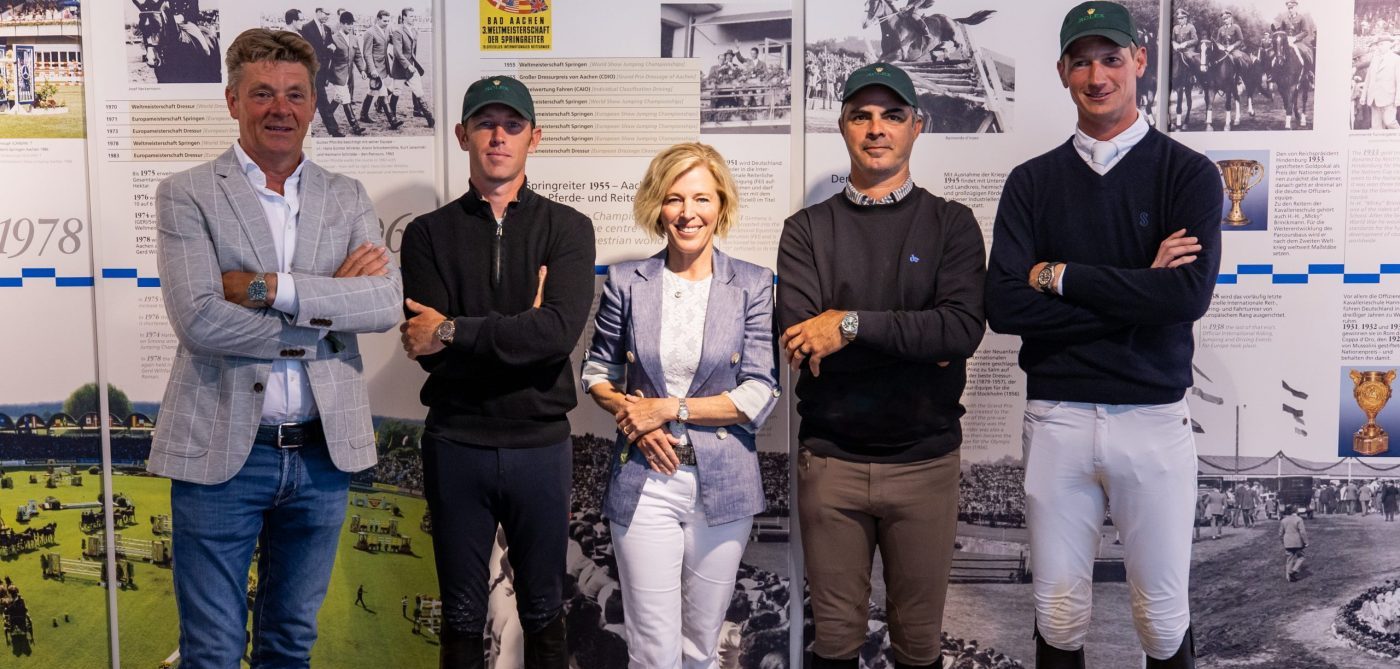
They all have something in common: Meredith Michaels Beerbaum, Scott Brash, Daniel Deusser, Jeroen Dubbeldam and Rodrigo Pessoa have made their mark on the big winner’s podium with their victories at the Rolex Grand Prix at the Chio Aachen, writing sporting history. As part of the 25th anniversary partnership between Rolex and the Chio Aachen, spring-reiter.de had the opportunity to speak with the Rolex Testimonials and spring sports legends about their memories of these great victories, about the requirements that the horse and rider must possess to win here, and about how important it is to give something back to the sport and the young talent.
It has been an incredible 30 years since Rodrigo Pesso wrote history with Special Envoy in Aachen. In 1994, he competed against his father Nelson in the Rolex Grand Prix. Both of them made it to the final and in the end Rodrigo won, his father came in third.
Rodrigo Pessoa (RD) revisits the day: „Even though it has been 30 years, I remember everything that happened on that day. It was very sunny, the stadium was full, as it is every year at CHIO Aachen, and it was a very special day. With my father in the competition, it was of course something very special and we had two chances in the family to win the competition. My father had already won twice, so it would have been a hat-trick for him. He was the first in the competition and he was very fast and very good, but he was later overtaken by Thomas Fuchs, Martin’s father. I was seventh out of nine participants at the end of the competition. Special Envoy was in good shape, I knew that we had to try everything to win the competition, and it worked out. I remember everything about that day, it is an unforgettable memory.“
Scott Brash (SB) won the Grand Prix at CHIO Aachen with Hello Sanctos in 2015; that same year, he also triumphed in the Rolex Grand Slam. Today – eight years later – not a single rider has been able to repeat this incredible feat.
Scott Brash recounts: „It doesn’t feel like it’s been eight years since I won, it feels like yesterday. It was an incredible moment and one of the best feelings you can have – I was the last one, and when I galloped over the finish line and looked at the clock that we had managed it, it was just incredible. Hello Sanctos is the horse of my life. I think what made him so special was his mind, he was so clever and so economical in the jumping, he wasn’t a big flashy jumper, but he knew exactly where his legs were and where the poles were. He always adapted to the circumstances, the bigger the course, the better for him“
Scott, do you think it's still possible to win the Rolex Grand Slam of showjumping again?
SB smiles: „Of course, another rider can also achieve the Rolex Grand Slam. Everything has to go right; you need a remarkable horse or horses to win the four majors, and you also need a bit of luck. It’s doable, but it’s going to be damn hard.“
Daniel Deusser (DD) has established himself on the grand prize-winning podium in Aachen in 2021 with his victory on the saddle of Killer Queen VDM.
DD says: „It’s something very special to win a competition like the Rolex Grand Prix at a major, because you don’t always have a horse that you can compete in such a competition, and when the moment comes when you feel like you can win a major, you try to make the best of it. Fortunately, I was able to win in 2021, because I had been second twice, which meant that I didn’t want to be second again and thought about what I could and should have done differently. I still remember how Scott won and I came second, when I actually thought I had ridden a very good run with very tight turns. So when I had to enter the course at the start of the run in 2021, I jumped faultlessly, but I wasn’t sure if I would win; in the end, it was my lucky day. One or two were faster, but they had a drop, and the others, who were flawless, just weren’t fast enough. So on this day everything worked out. I had a very good horse that I could ride well on the obstacles, and the other riders simply didn’t manage that on this day. This underlines how tight it is in sports, because it’s not just two or three riders who can win the Rolex Grand Prix at CHIO Aachen, but 15 to 20.“
When you had to make the first move, what was the tactic?
DD: „As the first rider in the heats, you don’t naturally have the best starting position, but you can’t change it. So you have to try to give your best. Of course, I wanted to put pressure on the others, but at that moment I was just lucky. I remember that the year after that, at the CHIO Aachen in the Grand Prix Rolex, I was leading and in the end I only finished fourth, even though I thought the heat had gone well. You make a plan based on how the horse feels before the heat, and in the end it has to work out and of course you also have to have a bit of luck.‚
The World and European Champion Jeroen Dubbeldam (JD) (Aachen Sieger 2001 on De Sjiem) has won almost everything there is to win.
How long does it take and what experience is required for up-and-coming riders to come to CHIO Aachen and compete in an event like the Rolex Grand Prix?
Jeroen Dubbeldam: „It's a long journey, a long way to get there, and that will always be the case. I think it's very important for the young generation to see what happens here in the arena, but even more important is what goes on behind the scenes and what efforts are required to follow a course like that at Chio Aachen. There is a whole world behind the scenes before you enter this arena. It is very important that the young riders are aware of this, and that's why it's important that we accompany them on this path and make them true horse people. I think it's our job to guide the new generation on this path.“
If you had to pick out one or two qualities of a young rider, which would they be?
JD: „I think the most important quality is that they love their profession and enjoy working with horses. They also need to be able to work hard and be very disciplined. These are boring standards that are repeated over and over again, but they are so important. It all starts with loving the work of working with horses, and then everything else is easier to accomplish. There are many talented young riders who can ride a horse very well and have a good eye for riding over obstacles, but I think what ultimately makes the difference are hard work and discipline. I have seen so many talented young riders throughout my career, but being talented can also be very dangerous when you are young, because it can make you a bit lazy. I think it is important that we do everything we can to prepare the next generation well, because talent is great, but it can also be very dangerous.“
Meredith Michaels-Beerbaum (MMB) She is the first and so far only woman to have led the world rankings. She won the Rolex Grand Prix in Aachen in 2005 on Shutterfly and today she trains her daughter Brianne and other young riders.
How important is it for you to give something back to the sport and to help the next generation win some of the top prizes here at the CHIO Aachen?
Meredith Michaels-Beerbaum: „It has started a new era in my career and I really enjoy giving back to the next generation, especially to my daughter who is now fourteen and is doing quite well riding. It is so wonderful for me to be part of this journey and to see them grow. My husband and I never thought she would one day become a rider, but she has a great passion for horses, she enjoys it and works very hard. Just like Jeroen said, she is talented, but she also works hard and invests so much time and effort into her riding. For me, it is a blessing to be able to experience the many stages again through my daughter. I love giving her advice and being able to tell her stories about what it was like for me. I think it’s a great advantage for me that I can not only teach her important training techniques, but also tell her about my successes and failures and how I managed to persevere. This is my new journey, and I really enjoy it. I have also worked at the Aachen CAMPUS, supported by Rolex, and trained the young rider. I think it is so important for us athletes to give something back to the sport we were able to enjoy.“
Was winning the Rolex Grand Prix here in Aachen something you dreamed about as a young girl from California?
MMB: „This question makes me feel goosebumps. I came to Aachen for the first time as an 18-year-old girl from Los Angeles, and I will never forget how I looked around and thought: ‚If I could ever ride here, that would be fantastic.‘ That was the first thing I wished to come here and ride. Many years later, I came as an American, as part of the Nations Cup team – I managed to do it, but it wasn’t a great success. Then, years later, I changed my nationality because I married my husband Markus, and I started riding for Germany. The first big step for me was to get into the German Nations Cup team, and a few weeks later I was also in talks for the European Championship team in Hickstead. Herbert Mayer, the head of the German national team, considered whether to include a woman in the team for the first time ever. He wanted to see me in Aachen and then decide. In the qualifying round on Wednesday, my wonderful mare Stella spun in the air over the last obstacle, and I fell, but I managed to stay on the horse until after the finish line and complete the course, but I fell and the horse galloped right at me. I will never forget how Herbert came to me and said, ‚Can you ride the Nations Cup‘, and I said, ‚Of course‘, and I managed a zero round and a round with 4 penalty points, and a few weeks later I took part in the European Championships.
From then on, I had my great partnership with Shutterlfy, but it was always my goal to win the Grand Prix here. When it finally came to it, I was so focused all week and thought: ‚This is what I want to do.‘ I still remember exactly how I stayed flawless in the first round and thought: ‚Okay, that was the first round, now comes the second round.‘ The relief and joy over winning that challenge were indescribable.“
Jeroen, is there a moment in your career that you can call particularly outstanding?
JD: „That’s a very difficult question, because I’ve had so many great moments in my career and many of them, fortunately, under the flag of Rolex. I don’t think I can pinpoint a particular moment because there were some that were so special. I really enjoyed winning the World Championships in Caen, with the horse change, which was fun for me. I was lucky to be there a few times and to win a few times, so it was a special situation because you could ride some of the best horses in the world at that time. If I have to pick one moment when we – me and my horse, in this case Zenith – as a pair were at our best, then I have to go back to the 2015 European Championships, where I felt that we couldn’t have been in better shape. Zenith was in top form and so was I, and together we felt that nothing could go wrong and in the end I became European Champion.“
What qualities do you think riders and horses need to possess in order to win a major?
SB: „You have to have an incredible strong partnership with a horse. That comes from years of daily work. To win a Rolex Major, you really have to know your horse – I can’t remember anyone winning the Rolex Grand Prix a few weeks later who only had their horse under saddle for a short time. You need years of training, you have to know your horse inside out – you have to know how the horse reacts on a line, how many galloping jumps you have to do, because every horse is different. Experience is also important – you can ride a horse differently if you know that it has experience in the course. Furthermore, there are so many qualities we look for in a horse – stamina, caution, speed – but even if it has all these qualities, you have to nurture them in the right way and develop the partnership.“
If you could relive one day from the past, which day would it be and why?
DD: „In my case, that would definitely be my victory at the Rolex Grand Prix in Aachen 2021. Of course, it’s always fantastic to win, but starting in Aachen with the German audience behind me, even if I finish second, that’s fantastic and I’d like to experience those moments again.“
MBM: „I agree that the Rolex Grand Prix here was so special because I had set out to win it. As an athlete to achieve something that you have worked for your whole life and then actually bring it home is truly an incredible feeling. Two of my other favorite victories were the Rolex IJRC Top 10 Final at CHI Geneva – that is an incredible competition, and to win it against the top ten athletes in the world was just incredible for me.“
Meredith, you mentioned your daughter. What is the best advice you can give to children who want to get involved in sports – how can they reconcile competing with other aspects of life such as school?
MBM: „It’s a difficult path. For me and my family, it worked quite well in the year we got Covid, as Brianne’s school went online – we spend three months of the year in Wellington in the USA and participate in tournaments, and my daughter was able to continue her schooling online while also participating in tournaments abroad. My husband and I made it very clear that education is important, and we are lucky that they take education very seriously – that’s a very high priority for us. We never pushed our daughter into horseback riding, and I think that’s very important. It’s important not to push a young person or put them under pressure, and also to convey to them that it’s a long journey, because it can easily happen that you get fixated on the successes or the highs and lows. We always support them, and I often tell them when they’re nervous before an event: ‚I love you, no matter what happens‘, and that’s really important, this kind of support, because she’s a perfectionist – she has to know that it’s not just about winning – it’s a long road.“
Can you explain how you prepare for a tournament like CHIO Aachen and the other Rolex Grand Slam of Show Jumping Majors?
DD: „You can’t just prepare for one Grand Prix or one single tournament. You have to build the horse over a period of many, many years – of course you can make a special plan for the last few weeks, but you have to be ready a few weeks in advance, and it’s not a last-minute story. It takes years, starting with the show jumping tests where the horses gain experience in different riding halls and classes, building on their knowledge and experience until they are ready for such a competition.“
The Gras Arena at CHIO Aachen is so large and unique; can you give us an idea of how to ride in this special arena?
RP: „It’s a very special place. Horses that do well here have often been there twice or three times – they rarely do well the first time. The atmosphere, the mood in the air, you can feel it – the horses that do well here have been here many times and feel at ease in the arena and in the surroundings, so they can grow beyond themselves and are able to achieve great things.“
SB: „I agree with that. You have to have a good rhythm with your horse, you need a good gallop and you have to ensure that the horse is confident. I always try to get into a nice forward rhythm and to make sure that the horses have confidence.“
DD: „Forward rhythm – that’s something you definitely need. The obstacles have changed over the last 20 years; it’s still big jumps, but the obstacles are now easier; we have many very light poles and different lines – the distances between the jumps are still long and a big gallop in this arena is definitely an advantage.“
MBM: „I agree with everything – Rodrigo said experience – Shutterfly started here as a seven-year-old in the junior horse classes and he didn’t miss a year until he retired at 18 in Aachen. It was many years of experience for him and me to be able to do that. I also agree that you have to be brave and able to gallop – it’s not a place for cautious, backward-oriented riding – you have to ride forward and trust the horse.“
JD: „Forward control is much more difficult, and it is always a key word when teaching my students. They are supposed to ride forward and not lose control. In this course, this is very important, because it is huge and time is limited, so one must be able to gallop quickly and not lose control at high speed. Another tip is not to get too far from the first obstacle when the bell rings, as it can take a very long time to get from one end of the arena to the other.“